welcome

welcome To Legend web blog

Saturday, June 30, 2012

Astronomers Discover Planetary Odd Couple

Astronomers have discovered a pair of neighboring planets with dissimilar densities orbiting very close to each other. The planets are too close to their star to be in the so-called "habitable zone," the region in a system where liquid water might exist on the surface, but they have the closest-spaced orbits ever confirmed. The findings are published today in the journal Science.

The research team, led by Josh Carter, a Hubble fellow at the Harvard-Smithsonian Center for Astrophysics in Cambridge, Mass., and Eric Agol, a professor of astronomy at the University of Washington in Seattle, used data from NASA's Kepler space telescope, which measures dips in the brightness of more than 150,000 stars, to search for transiting planets.

The inner planet, Kepler-36b, orbits its host star every 13.8 days and the outer planet, Kepler-36c, every 16.2 days. On their closest approach, the neighboring duo comes within about 1.2 million miles of each other. This is only five times the Earth-moon distance and about 20 times closer to one another than any two planets in our solar system.
 

Source: NASA
www.afgastronomers.blogspot.com


Thursday, June 28, 2012

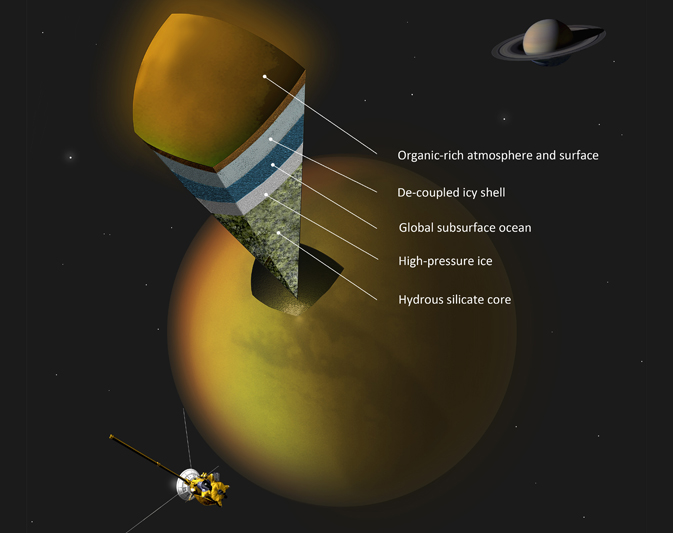
Cassini Finds Likely Subsurface Ocean on Saturn Moon

Data from NASA's Cassini spacecraft have revealed Saturn's moon Titan likely harbors a layer of liquid water under its ice shell.
Researchers saw a large amount of squeezing and stretching as the moon orbited Saturn. They deduced that if Titan were composed entirely of stiff rock, the gravitational attraction of Saturn would cause bulges, or solid "tides," on the moon only 3 feet (1 meter) in height. Spacecraft data show Saturn creates solid tides approximately 30 feet (10 meters) in height, which suggests Titan is not made entirely of solid rocky material. The finding appears in today's edition of the journal Science.

"Cassini's detection of large tides on Titan leads to the almost inescapable conclusion that there is a hidden ocean at depth," said Luciano Iess, the paper's lead author and a Cassini team member at the Sapienza University of Rome, Italy. "The search for water is an important goal in solar system exploration, and now we've spotted another place where it is abundant."
Titan takes only 16 days to orbit Saturn, and scientists were able to study the moon's shape at different parts of its orbit. Because Titan is not spherical, but slightly elongated like a football, its long axis grew when it was closer to Saturn. Eight days later, when Titan was farther from Saturn, it became less elongated and more nearly round. Cassini measured the gravitational effect of that squeeze and pull.
Scientists were not sure Cassini would be able to detect the bulges caused by Saturn's pull on Titan. By studying six close flybys of Titan from Feb. 27, 2006, to Feb. 18, 2011, researchers were able to determine the moon's internal structure by measuring variations in the gravitational pull of Titan using data returned to NASA's Deep Space Network (DSN).

"We were making ultrasensitive measurements, and thankfully Cassini and the DSN were able to maintain a very stable link," said Sami Asmar, a Cassini team member at NASA's Jet Propulsion Laboratory in Pasadena, Calif. "The tides on Titan pulled up by Saturn aren't huge compared to the pull the biggest planet, Jupiter, has on some of its moons. But, short of being able to drill on Titan's surface, the gravity measurements provide the best data we have of Titan's internal structure."

An ocean layer does not have to be huge or deep to create these tides. A liquid layer between the external, deformable shell and a solid mantle would enable Titan to bulge and compress as it orbits Saturn. Because Titan's surface is mostly made of water ice, which is abundant in moons of the outer solar system, scientists infer Titan's ocean is likely mostly liquid water.
On Earth, tides result from the gravitational attraction of the moon and sun pulling on our surface oceans. In the open oceans, those can be as high as two feet (60 centimeters). While water is easier to move, the gravitational pulling by the sun and moon also causes Earth's crust to bulge in solid tides of about 20 inches (50 centimeters).
The presence of a subsurface layer of liquid water at Titan is not itself an indicator for life. Scientists think life is more likely to arise when liquid water is in contact with rock, and these measurements cannot tell whether the ocean bottom is made up of rock or ice. The results have a bigger implication for the mystery of methane replenishment on Titan.
"The presence of a liquid water layer in Titan is important because we want to understand how methane is stored in Titan's interior and how it may outgas to the surface," said Jonathan Lunine, a Cassini team member at Cornell University, Ithaca, N.Y. "This is important because everything that is unique about Titan derives from the presence of abundant methane, yet the methane in the atmosphere is unstable and will be destroyed on geologically short timescales."
A liquid water ocean, "salted" with ammonia, could produce buoyant ammonia-water liquids that bubble up through the crust and liberate methane from the ice. Such an ocean could serve also as a deep reservoir for storing methane.

Source : NASA
www.afgastronomers.blogspot.com
Monday, April 2, 2012

Hubble Spies a Spiral Galaxy Edge-on

The NASA/ESA Hubble Space Telescope has spotted the "UFO Galaxy." NGC 2683 is a spiral galaxy seen almost edge-on, giving it the shape of a classic science fiction spaceship. This is why the astronomers at the Astronaut Memorial Planetarium and Observatory, Cocoa, Fla., gave it this attention-grabbing nickname.

While a bird's eye view lets us see the detailed structure of a galaxy (such as this Hubble image of a barred spiral), a side-on view has its own perks. In particular, it gives astronomers a great opportunity to see the delicate dusty lanes of the spiral arms silhouetted against the golden haze of the galaxy’s core. In addition, brilliant clusters of young blue stars shine scattered throughout the disc, mapping the galaxy’s star-forming regions.

Perhaps surprisingly, side-on views of galaxies like this one do not prevent astronomers from deducing their structures. Studies of the properties of the light coming from NGC 2683 suggest that this is a barred spiral galaxy, even though the angle we see it at does not let us see this directly.

Friday, March 16, 2012

NASA Releases New WISE Mission Catalog of Entire Infrared Sky

NASA unveiled a new atlas and catalog of the entire infrared sky today showing more than a half billion stars, galaxies and other objects captured by the Wide-field Infrared Survey Explorer (WISE) mission.
"Today, WISE delivers the fruit of 14 years of effort to the astronomical community," said Edward Wright, WISE principal investigator at UCLA, who first began working on the mission with other team members in 1998.
WISE launched Dec. 14, 2009, and mapped the entire sky in 2010 with vastly better sensitivity than its predecessors. It collected more than 2.7 million images taken at four infrared wavelengths of light, capturing everything from nearby asteroids to distant galaxies. Since then, the team has been processing more than 15 trillion bytes of returned data. A preliminary release of WISE data, covering the first half of the sky surveyed, was made last April.
The WISE catalog of the entire sky meets the mission's fundamental objective. The individual WISE exposures have been combined into an atlas of more than 18,000 images covering the sky and a catalog listing the infrared properties of more than 560 million individual objects found in the images. Most of the objects are stars and galaxies, with roughly equal numbers of each. Many of them have never been seen before.

WISE observations have led to numerous discoveries, including the elusive, coolest class of stars. Astronomers hunted for these failed stars, called "Y-dwarfs," for more than a decade. Because they have been cooling since their formation, they don't shine in visible light and could not be spotted until WISE mapped the sky with its infrared vision.
WISE also took a poll of near-Earth asteroids, finding there are significantly fewer mid-size objects than previously thought. It also determined NASA has found more than 90 percent of the largest near-Earth asteroids.

Other discoveries were unexpected. WISE found the first known "Trojan" asteroid to share the same orbital path around the sun as Earth. One of the images released today shows a surprising view of an "echo" of infrared light surrounding an exploded star. The echo was etched in the clouds of gas and dust when the flash of light from the supernova explosion heated surrounding clouds. At least 100 papers on the results from the WISE survey already have been published. More discoveries are expected now that astronomers have access to the whole sky as seen by the spacecraft.

"With the release of the all-sky catalog and atlas, WISE joins the pantheon of great sky surveys that have led to many remarkable discoveries about the universe," said Roc Cutri, who leads the WISE data processing and archiving effort at the Infrared and Processing Analysis Center at the California Institute of Technology in Pasadena. "It will be exciting and rewarding to see the innovative ways the science and educational communities will use WISE in their studies now that they have the data at their fingertips."

Source :NASA
www.afgastronomers.blogspot.com

Tuesday, February 28, 2012

Five Solar Eruptions in 2 Days – Beautiful High Latitude Aurora Result From Active Solar Weekend

UPDATE 02.27.12: Beautiful High Latitude Aurora Sighted
The weak CME impact on February 26, 2012 did cause some aurora in high latitude locations after a modest start. The above image was captured over Muonio, Finland late last night, a gorgeous ending to a weekend of spectacular solar eruptions and CMEs.
---------------------------------------------------------------------------------------------------------
UPDATE 02.26.12: Weak CME Impact

Though the February 24, 2012 solar eruption provided quite a show, the associated coronal mass ejection (CME) that impacted Earth's magnetic field on Feb. 26, 2012 around 4:00pm EST (2100 UT) was weak and does not appear set to cause a strong geomagnetic storm.

From February 23 through February 24 our sun produced an astonishing five solar eruptions, launched from the top, bottom, left and right sides of the solar disk. Four of those eruptions came in just a 24 hour period.

One of the eruptions, a large snaking magnetic filament, erupted during the early hours of February 24, 2012 and launched the first of two coronal mass ejections (CME) in Earth’s direction. Analysis by scientist at the Goddard Space Weather Lab shows that this CME cloud will strike Earth's magnetic field on February 26, 2012 near 8:30am EST (+/- 7 hr). Geomagnetic storms and aurora are possible when the CME arrives.


The filament eruption, as seen in the video above taken by the Solar Dynamic Observatory (SDO) in extreme ultraviolet wavelength, forms a visible split in the sun's atmosphere, where plasma races away in waves in opposite directions. The divide stretches the length of the original filament location, almost 248,500 miles (400,000 km).

Solar filaments are darker, cooler solar material floating above the sun's surface, suspended by magnetic forces. When they appear over the solar limb they are called prominences.


Source : NASA
www.afgastronomers.blogspot.com


Sunday, February 26, 2012

Aiming for an Open Window
 Why does NASA sometimes schedule a rocket launch for the middle of the night, or aim for a liftoff time when weather is notoriously unlikely to cooperate?

The simplicity of the question belies the complexity of the answer. The best time to start a mission is based on a blend of factors: the flight's target and goals, the needs of the spacecraft, the type of rocket, and the desired trajectory, which refers to the path the vehicle and spacecraft must take to successfully start the mission. Not only do these variables influence the preferred launch time -- the ideal time of departure -- but the overall length of the launch window, which can vary from one second to several hours.

The dynamics change from mission to mission, and determining the launch window is an important part of the overall flight design.
"The interesting thing about our job is each mission is almost completely different from any other mission," said Eric Haddox, the lead flight design engineer in NASA's Launch Services Program (LSP), based at Kennedy Space Center in Florida.
Haddox leads the team of agency and contractor personnel overseeing and integrating the trajectory design efforts of the spacecraft team and launch service contractor for each LSP mission. Once the spacecraft team identifies its needs, a rocket is selected, and the work of hammering out the best launch window and trajectory begins. Ultimately, the launch window and preferred liftoff time are set by the launch service contractor.

"We help everybody understand the requirements of the spacecraft and what the capabilities are of the launch vehicle, and try to mesh the two," Haddox explained.

The most significant deciding factors in when to launch are where the spacecraft is headed, and what its solar needs are. Earth-observing spacecraft, for example, may be sent into low-Earth orbit. Some payloads must arrive at a specific point at a precise time, perhaps to rendezvous with another object or join a constellation of satellites already in place. Missions to the moon or a planet involve aiming for a moving object a long distance away.            
                                                                       
For example, NASA's Mars Science Laboratory spacecraft began its eight-month journey to the Red Planet on Nov. 26, 2011 with a launch aboard a United Launch Alliance (ULA) Atlas V rocket from Cape Canaveral Air Force Station in Florida. After the initial push from the powerful Atlas V booster, the Centaur upper stage then sent the spacecraft away from Earth on a specific track to place the laboratory, with its car-sized Curiosity rover, inside Mars' Gale Crater on Aug. 6, 2012. Due to the location of Mars relative to Earth, the prime planetary launch opportunity for the Red Planet occurs only once every 26 months.

Additionally, spacecraft often have solar requirements: they may need sunlight to perform the science necessary to meet the mission's objectives, or they may need to avoid the sun's light in order to look deeper into the dark, distant reaches of space.

Such precision was needed for NASA's Suomi National Polar-orbiting Partnership (NPP) spacecraft, which launched Oct. 28, 2011 aboard a ULA Delta II rocket from Vandenberg Air Force Base in California. The Earth-observing satellite circles at an altitude of 512 miles, sweeping from pole to pole 14 times each day as the planet turns on its axis. A very limited launch window was required so that the spacecraft would cross the ascending node at exactly 1:30 p.m. local time and scan Earth's surface twice each day, always at the same local time.

All of these variables influence a flight's trajectory and launch time. A low-Earth mission with specific timing needs must lift off at the right time to slip into the same orbit as its target; a planetary mission typically has to launch when the trajectory will take it away from Earth and out on the correct course.

According to Haddox, aiming for a specific target -- another planet, a rendezvous point, or even a specific location in Earth orbit where the solar conditions will be just right -- is a bit like skeet shooting.

"You've got this object that's going to go flying out into the air and you've got to shoot it," said Haddox. "You have to be able to judge how far away your target is and how fast it's moving, and make sure you reach the same point at the same time."

But Haddox also emphasized that Earth is rotating on its axis while it orbits the sun, making the launch pad a moving platform. With so many moving players, launch windows and trajectories must be carefully choreographed.
Of course, weather or technical problems can interfere with the team's best plans. Launch windows are intended to absorb small delays while still offering plenty of chances to lift off on a given day. However, launching at a time other than the preferred time could reduce the rocket's performance, potentially limiting the payload mass.

"To launch at any time other than that optimal time, you're going to have to alter the trajectory, steer the rocket to get back to that point," Haddox said. "So that's where it becomes a trade of, 'Okay, if my window were a half hour long, how much performance would I need to fly at any time within a half hour? Or, if my window were an hour long, how much performance would I be able to get out of the rocket to fly at any time within that one hour?'"

Likewise, if a spacecraft has to use any of its onboard propellant to make up for any difference in the trajectory, that could impact the entire mission.

"The more propellant they have, the longer they can do maneuvers or adjust things" during the flight, Haddox explained. "It basically equates to how long they can stay in orbit and do their science."

These potential give-and-take situations are carefully considered during flight planning. Mission managers must find a way to balance the sacrifices while maximizing the chance of getting off the ground.


   Even when the launch and mission teams have chosen the best launch window, they face an additional challenge from the U.S. Air Force: collision avoidance, also called COLA. The U.S. Air Force's 45th Space Wing controls the Eastern Range surrounding Cape Canaveral Air Force Station in Florida; the 30th Space Wing operates the Western Range, including Vandenberg Air Force Base. The range determines whether any orbiting spacecraft or debris could strike the vehicle during its climb to space, and cut out portions of the launch window that are too risky.

Collision avoidance can get tricky, because even though the trajectory has been carefully planned, real-time factors result in some uncertainty. For example, during the trajectory design process, the team assumes certain propellant temperatures. But if the temperatures are slightly different on launch day, that will affect the propellant, which in turn alters the efficiency of the rocket's engines or solid rocket motors.

"The navigation system on the rocket is going to do what it needs to do to get the spacecraft where it needs to be, but it's not going to be the same trajectory you looked at before," said Haddox. "When you've got things that are moving seven to eight kilometers a second, half a second can result in a big distance."

"So it just makes things a lot harder to predict," he added.

On launch day, Haddox and other members of the flight design team are involved in the countdown. Even in the final hours before liftoff, they continue to fine-tune the trajectory analysis based on real-time data collected from weather balloons, ensuring the safety of the rocket and spacecraft as the window opens for another successful mission.

Source : NASA
www.afgastronomers.blogspot.com

Curiosity, The Stunt Double

With a pair of bug-eyes swiveling on a stalk nearly 8 feet off the ground, the 6-wheeled, 1800-lb Mars rover Curiosity doesn't look much like a human being. Yet, right now, the mini-Cooper-sized rover is playing the role of stunt double for NASA astronauts.

"Curiosity is riding to Mars in the belly of a spacecraft, where an astronaut would be," explains Don Hassler of the Southwest Research Institute in Boulder, Colorado. "This means the rover experiences deep-space radiation storms in the same way that a real astronaut would."

Indeed, on Jan. 27th, 2012, Curiosity's spacecraft was hit by the most intense solar radiation storm since 2005. The event began when sunspot AR1402 produced an X2-class solar flare. (On the "Richter Scale of Solar Flares," X-flares are the most powerful kind.) The explosion accelerated a fusillade of protons and electrons to nearly light speed; these subatomic bullets were guided by the sun's magnetic field almost directly toward Curiosity.

When the particles hit the outer walls of the spacecraft, they shattered other atoms and molecules in their path, producing a secondary spray of radiation that Curiosity both absorbed and measured.


When the particles hit the outer walls of the spacecraft, they shattered other atoms and molecules in their path, producing a secondary spray of radiation that Curiosity both absorbed and measured.

"Curiosity was in no danger," says Hassler. "In fact, we intended all along for the rover to experience these storms en route to Mars."

Unlike previous Mars rovers, Curiosity is equipped with a Radiation Assessment Detector. The instrument, nicknamed "RAD," counts cosmic rays, neutrons, protons and other particles over a wide range of biologically-interesting energies. RAD's prime mission is to investigate the radiation environment on the surface of Mars, but researchers have turned it on early so that it can also probe the radiation environment on the way to Mars as well.

Curiosity's location inside the spacecraft is key to the experiment.

"We have a pretty good idea what the radiation environment is like outside," says Hassler, who is the principal investigator for RAD. "Inside the spacecraft, however, is still a mystery."


Even supercomputers have trouble calculating exactly what happens when high-energy cosmic rays and solar energetic particles hit the walls of a spacecraft. One particle hits another; fragments fly; the fragments themselves crash into other molecules.

"It's very complicated. Curiosity is giving us a chance to actually measure what happens."

Even when the sun is quiet, Curiosity is bombarded by a slow drizzle of cosmic rays—high-energy particles accelerated by distant black holes and supernova explosions. In the aftermath of the Jan. 27th X-flare, RAD detected a surge of particles several times more numerous than the usual cosmic ray counts. Hassler's team is still analyzing the data to understand what it is telling them about the response of the spacecraft to the storm.


More X-flares will help by adding to the data set. Hassler expects the sun to cooperate, because the solar cycle is trending upward toward a maximum expected in early 2013.

As of February 2012, "we still have 6 months to go before we reach Mars. That's plenty of time for more solar storms."

A stunt double's work is never done.

Source : NASA
http://www.afgastronomers.blogspot.com/