welcome

welcome To Legend web blog

Monday, November 5, 2012


Hubble Sees an Unexpected Population of Young-Looking Stars

The NASA/ESA Hubble Space Telescope offers an impressive view of the center of globular cluster NGC 6362. The image of this spherical collection of stars takes a deeper look at the core of the globular cluster, which contains a high concentration of stars with different colors.

Tightly bound by gravity, globular clusters are composed of old stars, which, at around 10 billion years old, are much older than the sun. These clusters are fairly common, with more than 150 currently known in our galaxy, the Milky Way, and more which have been spotted in other galaxies.

Globular clusters are among the oldest structures in the Universe that are accessible to direct observational investigation, making them living fossils from the early years of the cosmos.

Astronomers infer important properties of globular clusters by looking at the light from their constituent stars. For many years, they were regarded as ideal laboratories for testing the standard stellar evolution theory. Among other things, this theory suggests that most of the stars within a globular cluster should be of a similar age.

Recently, however, high precision measurements performed in numerous globular clusters, primarily with the Hubble Space Telescope, have led some to question this widely accepted theory. In particular, certain stars appear younger and bluer than their companions, and they have been dubbed blue stragglers. NGC 6362 contains many of these stars.

Since they are usually found in the core regions of clusters, where the concentration of stars is large, the most likely explanation for this unexpected population of objects seems to be that they could be either the result of stellar collisions or transfer of material between stars in binary systems. This influx of new material would heat up the star and make it appear younger than its neighbors.

NGC 6362 is located about 25 000 light-years from Earth in the constellation of Ara (The Altar). British astronomer James Dunlop first observed this globular cluster on 30 June 1826.

This image was created combining ultraviolet, visual and infrared images taken with the Wide Field Channel of the Advanced Camera for Surveys and the Wide Field Camera 3. An image of NGC 6362 taken by the MPG/ESO 2.2-meter telescope will be published by the European Southern Observatory on Wednesday.

Source : NASA


Wednesday, September 5, 2012

Hubble Spotted a Supernova in NGC 5806

New image from the NASA/ESA Hubble Space Telescope shows NGC 5806, a spiral galaxy in the constellation Virgo (the Virgin). It lies around 80 million light years from Earth. Also visible in this image is a supernova explosion called SN 2004dg.

The exposures that are combined into this image were carried out in early 2005 in order to help pinpoint the location of the supernova, which exploded in 2004. The afterglow from this outburst of light, caused by a giant star exploding at the end of its life, can be seen as a faint yellowish dot near the bottom of the galaxy.
NGC 5806 was chosen to be one of a number of galaxies in a study into supernovae because Hubble’s archive already contained high resolution imagery of the galaxy, collected before the star had exploded. Since supernovae are both relatively rare, and impossible to predict with any accuracy, the existence of such before-and-after images is precious for astronomers who study these violent events.

Aside from the supernova, NGC 5806 is a relatively unremarkable galaxy: it is neither particularly large or small, nor especially close or distant.

The galaxy’s bulge (the densest part in the center of the spiral arms) is a so-called disk-type bulge, in which the spiral structure extends right to the center of the galaxy, instead of there being a large elliptical bulge of stars present. It is also home to an active galaxy nucleus, a supermassive black hole which is pulling in large amounts of matter from its immediate surroundings. As the matter spirals around the black hole, it heats up and emits powerful radiation.
This image is produced from three exposures in visible and infrared light, observed by Hubble’s Advanced Camera for Surveys. The field of view is approximately 3.3 by 1.7 arcminutes.

A version of this image was entered into the Hubble’s Hidden Treasures Image Processing Competition by contestant Andre van der Hoeven (who won second prize in the competition for his image of Messier 77). Hidden Treasures is an initiative to invite astronomy enthusiasts to search the Hubble archive for stunning images that have never been seen by the general public. The competition has now closed.

Source : NASA
www.afgastronomers.blogspot.com

NASA's Jupiter-Bound Juno Changes its Orbit

Earlier today, navigators and mission controllers for NASA's Juno mission to Jupiter watched their computer screens as their spacecraft successfully performed its first deep-space maneuver. This first firing of Juno's main engine is one of two planned to refine the spacecraft's trajectory, setting the stage for a gravity assist from a flyby of Earth on Oct 9, 2013. Juno will arrive at Jupiter on July 4, 2016.

The deep-space maneuver began at 6:57 p.m. EDT (3:57 p.m. PDT) today, when the Leros-1b main engine was fired for 29 minutes 39 seconds. Based on telemetry, the Juno project team believes the burn was accurate, changing the spacecraft's velocity by about 770 mph (344 meters a second) while consuming about 829 pounds (376 kilograms) of fuel.

"This first and successful main engine burn is the payoff for a lot of hard work and planning by the operations team," said Juno Project Manager Rick Nybakken of NASA's Jet Propulsion Laboratory in Pasadena, Calif. "We started detailed preparations for this maneuver earlier this year, and over the last five months we've been characterizing and configuring the spacecraft, primarily in the propulsion and thermal systems. Over the last two weeks, we have carried out planned events almost every day, including heating tanks, configuring subsystems, uplinking new sequences, turning off the instruments and increasing the spacecraft's spin rate. There is a lot that goes into a main engine burn."

The burn occurred when Juno was more than 300 million miles (483 million kilometers) away from Earth. A second deep space maneuver, of comparable duration and velocity change, is planned for Sept. 4. Together, they will place Juno on course for its Earth flyby, which will occur as the spacecraft is completing one elliptical orbit around the sun. The Earth flyby will boost Juno's velocity by 16,330 mph (about 7.3 kilometers per second), placing the spacecraft on its final flight path for Jupiter. The closest approach to Earth, on Oct. 9, 2013, will occur when Juno is at an altitude of about 310 miles (500 kilometers).

"We still have the Earth flyby and another 1.4 billion miles and four years to go to get to Jupiter," said Scott Bolton, Juno's principal investigator from the Southwest Research Institute in San Antonio. "The team will be busy during that whole time, collecting science on the way out to Jupiter and getting ready for our prime mission at Jupiter, which is focused on learning the history of how our solar system was formed. We need to go to Jupiter to learn our history because Jupiter is the largest of the planets, and it formed by grabbing most of the material left over from the sun's formation. Earth and the other planets are really made from the leftovers of the leftovers, so if we want to learn about the history of the elements that made Earth and life, we need to first understand what happened when Jupiter formed."

Juno was launched on Aug. 5, 2011. Once in orbit, the spacecraft will circle Jupiter 33 times, from pole-to-pole, and use its collection of eight science instruments to probe beneath the gas giant's obscuring cloud cover. Juno's science team will learn about Jupiter's origins, structure, atmosphere and magnetosphere, and look for a potential solid planetary core. Juno's name comes from Greek and Roman mythology. The god Jupiter drew a veil of clouds around himself to hide his mischief, and his wife, the goddess Juno, was able to peer through the clouds and reveal Jupiter's true nature.

Source : NASA
www.afgastronomers.blogspot.com

NASA's Dawn Prepares for Trek Toward Dwarf Planet

NASA's Dawn spacecraft is on track to become the first probe to orbit and study two distant solar system destinations, to help scientists answer questions about the formation of our solar system. The spacecraft is scheduled to leave the giant asteroid Vesta on Sept. 4 PDT (Sept. 5 EDT) to start its two-and-a-half-year journey to the dwarf planet Ceres.

Dawn began its 3-billion-mile (5-billion kilometer) odyssey to explore the two most massive objects in the main asteroid belt in 2007. Dawn arrived at Vesta in July 2011 and will reach Ceres in early 2015. Dawn's targets represent two icons of the asteroid belt that have been witness to much of our solar system's history.
To make its escape from Vesta, the spacecraft will spiral away as gently as it arrived, using a special, hyper-efficient system called ion propulsion. Dawn's ion propulsion system uses electricity to ionize xenon to generate thrust. The 12-inch-wide ion thrusters provide less power than conventional engines, but can maintain thrust for months at a time.

"Thrust is engaged, and we are now climbing away from Vesta atop a blue-green pillar of xenon ions," said Marc Rayman, Dawn's chief engineer and mission director, at NASA's Jet Propulsion Laboratory, Pasadena, Calif. "We are feeling somewhat wistful about concluding a fantastically productive and exciting exploration of Vesta, but now have our sights set on dwarf planet Ceres.
Dawn's orbit provided close-up views of Vesta, revealing unprecedented detail about the giant asteroid. The mission revealed that Vesta completely melted in the past, forming a layered body with an iron core. The spacecraft also revealed the scarring from titanic collisions Vesta suffered in its southern hemisphere, surviving not one but two colossal impacts in the last two billion years. Without Dawn, scientists would not have known about the dramatic troughs sculpted around Vesta, which are ripples from the two south polar impacts.

"We went to Vesta to fill in the blanks of our knowledge about the early history of our solar system," said Christopher Russell, Dawn's principal investigator, based at the University of California Los Angeles (UCLA). "Dawn has filled in those pages, and more, revealing to us how special Vesta is as a survivor from the earliest days of the solar system. We can now say with certainty that Vesta resembles a small planet more closely than a typical asteroid."

The mission to Vesta and Ceres is managed by NASA's Jet Propulsion Laboratory in Pasadena, Calif., for the agency's Science Mission Directorate in Washington. Dawn is a project of the directorate's Discovery Program, which is managed by NASA's Marshall Space Flight Center in Huntsville, Ala.

Source : NASA
www.afgastronomers.blogspot.com

Friday, July 27, 2012

NASA's Space Launch System Passes Major Agency Review, Moves to Preliminary Design

The rocket that will launch humans farther into space than ever before passed a major NASA review Wednesday. The Space Launch System (SLS) Program completed a combined System Requirements Review and System Definition Review, which set requirements of the overall launch vehicle system. SLS now moves ahead to its preliminary design phase.
The SLS will launch NASA's Orion spacecraft and other payloads, and provide an entirely new capability for human exploration beyond low Earth orbit.
These NASA reviews set technical, performance, cost and schedule requirements to provide on-time development of the heavy-lift rocket. As part of the process, an independent review board comprised of technical experts from across NASA evaluated SLS Program documents describing vehicle specifications, budget and schedule. The board confirmed SLS is ready to move from concept development to preliminary design.
"This new heavy-lift

 launch vehicle will make it possible for explorers to reach beyond our current limits, to nearby asteroids, Mars and its moons, and to destinations even farther across our solar system," said William Gerstenmaier, associate administrator for the Human Exploration and Operations Mission Directorate at NASA Headquarters in Washington. "The in-depth assessment confirmed the basic vehicle concepts of the SLS, allowing the team to move forward and start more detailed engineering design."

The reviews also confirmed the SLS system architecture and integration with the Orion spacecraft, managed by NASA's Johnson Space Center in Houston, and the Ground Systems Development and Operations Program, which manage the operations and launch facilities at NASA's Kennedy Space Center in Florida.

"This is a pivotal moment for this program and for NASA," said SLS Program Manager Todd May. "This has been a whirlwind experience from a design standpoint. Reaching this key development point in such a short period of time, while following the strict protocol and design standards set by NASA for human spaceflight is a testament to the team's commitment to delivering the nation's next heavy-lift launch vehicle."
SLS reached this major milestone less than 10 months after the program's inception. The combination of the two assessments represents a fundamentally different way of conducting NASA program reviews. The SLS team is streamlining processes to provide the nation with a safe, affordable and sustainable heavy-lift launch vehicle capability. The next major program milestone is preliminary design review, targeted for late next year.
The first test flight of NASA's Space Launch System, which will feature a configuration for a 70-metric-ton (77-ton) lift capacity, is scheduled for 2017. As SLS evolves, a three-stage launch vehicle configuration will provide a lift capability of 130 metric tons (143 tons) to enable missions beyond low Earth orbit and support deep space exploration.
NASA's Marshall Space Flight Center in Huntsville, Ala., manages the SLS program. Across the country NASA and its industry partners continue to make progress on SLS hardware that will be integrated into the final design. The RS-25 core stage and J-2X upper-stage rocket engine in development by Pratt & Whitney Rocketdyne of Canoga Park, Calif., for the future two-stage SLS, will be tested at NASA's Stennis Space Center in Mississippi. The prime contractor for the five-segment solid rocket boosters, ATK of Brigham City, Utah, has begun processing its first SLS boosters in preparation for an initial qualification test next year, ahead of their use for the first two exploration missions. The Boeing Co. in Huntsville is designing the SLS core stage, to be built at NASA's Michoud Assembly Facility in New Orleans and tested at Stennis before being shipped to Kennedy.

Source : NASA
www.afgastronomers.blogspot.com


Saturday, June 30, 2012

Astronomers Discover Planetary Odd Couple

Astronomers have discovered a pair of neighboring planets with dissimilar densities orbiting very close to each other. The planets are too close to their star to be in the so-called "habitable zone," the region in a system where liquid water might exist on the surface, but they have the closest-spaced orbits ever confirmed. The findings are published today in the journal Science.

The research team, led by Josh Carter, a Hubble fellow at the Harvard-Smithsonian Center for Astrophysics in Cambridge, Mass., and Eric Agol, a professor of astronomy at the University of Washington in Seattle, used data from NASA's Kepler space telescope, which measures dips in the brightness of more than 150,000 stars, to search for transiting planets.

The inner planet, Kepler-36b, orbits its host star every 13.8 days and the outer planet, Kepler-36c, every 16.2 days. On their closest approach, the neighboring duo comes within about 1.2 million miles of each other. This is only five times the Earth-moon distance and about 20 times closer to one another than any two planets in our solar system.
 

Source: NASA
www.afgastronomers.blogspot.com


Thursday, June 28, 2012

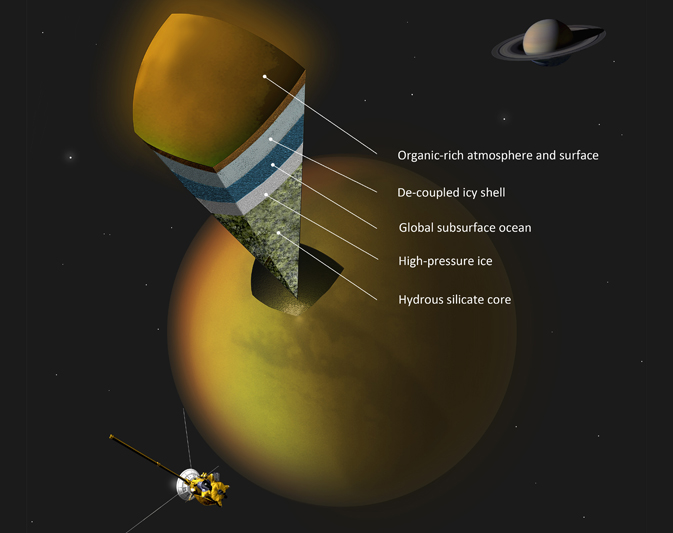
Cassini Finds Likely Subsurface Ocean on Saturn Moon

Data from NASA's Cassini spacecraft have revealed Saturn's moon Titan likely harbors a layer of liquid water under its ice shell.
Researchers saw a large amount of squeezing and stretching as the moon orbited Saturn. They deduced that if Titan were composed entirely of stiff rock, the gravitational attraction of Saturn would cause bulges, or solid "tides," on the moon only 3 feet (1 meter) in height. Spacecraft data show Saturn creates solid tides approximately 30 feet (10 meters) in height, which suggests Titan is not made entirely of solid rocky material. The finding appears in today's edition of the journal Science.

"Cassini's detection of large tides on Titan leads to the almost inescapable conclusion that there is a hidden ocean at depth," said Luciano Iess, the paper's lead author and a Cassini team member at the Sapienza University of Rome, Italy. "The search for water is an important goal in solar system exploration, and now we've spotted another place where it is abundant."
Titan takes only 16 days to orbit Saturn, and scientists were able to study the moon's shape at different parts of its orbit. Because Titan is not spherical, but slightly elongated like a football, its long axis grew when it was closer to Saturn. Eight days later, when Titan was farther from Saturn, it became less elongated and more nearly round. Cassini measured the gravitational effect of that squeeze and pull.
Scientists were not sure Cassini would be able to detect the bulges caused by Saturn's pull on Titan. By studying six close flybys of Titan from Feb. 27, 2006, to Feb. 18, 2011, researchers were able to determine the moon's internal structure by measuring variations in the gravitational pull of Titan using data returned to NASA's Deep Space Network (DSN).

"We were making ultrasensitive measurements, and thankfully Cassini and the DSN were able to maintain a very stable link," said Sami Asmar, a Cassini team member at NASA's Jet Propulsion Laboratory in Pasadena, Calif. "The tides on Titan pulled up by Saturn aren't huge compared to the pull the biggest planet, Jupiter, has on some of its moons. But, short of being able to drill on Titan's surface, the gravity measurements provide the best data we have of Titan's internal structure."

An ocean layer does not have to be huge or deep to create these tides. A liquid layer between the external, deformable shell and a solid mantle would enable Titan to bulge and compress as it orbits Saturn. Because Titan's surface is mostly made of water ice, which is abundant in moons of the outer solar system, scientists infer Titan's ocean is likely mostly liquid water.
On Earth, tides result from the gravitational attraction of the moon and sun pulling on our surface oceans. In the open oceans, those can be as high as two feet (60 centimeters). While water is easier to move, the gravitational pulling by the sun and moon also causes Earth's crust to bulge in solid tides of about 20 inches (50 centimeters).
The presence of a subsurface layer of liquid water at Titan is not itself an indicator for life. Scientists think life is more likely to arise when liquid water is in contact with rock, and these measurements cannot tell whether the ocean bottom is made up of rock or ice. The results have a bigger implication for the mystery of methane replenishment on Titan.
"The presence of a liquid water layer in Titan is important because we want to understand how methane is stored in Titan's interior and how it may outgas to the surface," said Jonathan Lunine, a Cassini team member at Cornell University, Ithaca, N.Y. "This is important because everything that is unique about Titan derives from the presence of abundant methane, yet the methane in the atmosphere is unstable and will be destroyed on geologically short timescales."
A liquid water ocean, "salted" with ammonia, could produce buoyant ammonia-water liquids that bubble up through the crust and liberate methane from the ice. Such an ocean could serve also as a deep reservoir for storing methane.

Source : NASA
www.afgastronomers.blogspot.com