welcome

welcome To Legend web blog

Friday, March 1, 2013

NASA's Van Allen Probes Discover a Surprise Circling Earth


After most NASA science spacecraft launches, researchers wait patiently for months as instruments on board are turned on one at a time, slowly ramped up to full power, and tested to make sure they work at full capacity. It's a rite of passage for any new satellite in space, and such a schedule was in place for the Van Allen Probes when they launched on Aug. 30, 2012, to study two giant belts of radiation that surround Earth.

But a group of scientists on the mission made a case for changing the plan. They asked that the Relativistic Electron Proton Telescope (REPT) be turned on early – just three days after launch -- in order that its observations would overlap with another mission called SAMPEX (Solar, Anomalous, and Magnetospheric Particle Explorer), that was soon going to de-orbit and re-enter Earth's atmosphere.

It was a lucky decision. Shortly before REPT turned on, solar activity on the sun had sent energy toward Earth that caused the radiation belts to swell. The REPT instrument worked well from the moment it was turned on Sep. 1. It made observations of these new particles trapped in the belts, recording their high energies, and the belts' increased size.

Then something happened no one had ever seen before: the particles settled into a new configuration, showing an extra, third belt extending out into space. Within mere days of launch, the Van Allen Probes showed scientists something that would require rewriting textbooks.

By the fifth day REPT was on, we could plot out our observations and watch the formation of a third radiation belt," says Shri Kanekal, the deputy mission scientist for the Van Allen Probes at NASA's Goddard Space Flight Center in Greenbelt, Md. and a coauthor of a paper on these results. "We started wondering if there was something wrong with our instruments. We checked everything, but there was nothing wrong with them. The third belt persisted beautifully, day after day, week after week, for four weeks."

The scientists published their results in a paper in the journal Science on Feb. 28, 2013. Incorporating this new configuration into their models of the radiation belts offers scientists new clues to what causes the changing shapes of the belts – a region that can sometimes swell dramatically in response to incoming energy from the sun, impacting satellites and spacecraft or pose potential threats to manned space flight.

The radiation belts, or Van Allen belts, were discovered with the very first launches of satellites in 1958 by James Van Allen. Subsequent missions have observed parts of the belts – including SAMPEX, which observed the belts from below – but what causes such dynamic variation in the belts has remained something of a mystery. Indeed, seemingly similar storms from the sun have at times caused completely different effects in the belts, or have sometimes led to no change at all.

The Van Allen Probes consist of two identical spacecraft with a mission to map out this region with exquisite detail, cataloguing a wide range of energies and particles, and tracking the zoo of magnetic waves that pulse through the area, sometimes kicking particles up to such frenzied speeds that they escape the belts altogether.

"We've had a long run of data from missions like SAMPEX," says Daniel Baker, who is the principal investigator for REPT at the University of Colorado in Boulder and first author on the Science paper. "But we've never been in the very throat of the accelerator operating a few hundred miles above our head, speeding these particles up to incredible velocities."

In its first six months in orbit, the instruments on the Van Allen Probes have worked exceptionally well and scientists are excited about a flood of observations coming in with unprecedented clarity. This is the first time scientists have been able to gather such a complete set of data about the belts, with the added bonus of watching from two separate spacecraft that can better show how events sweep across the area.

Spotting something new in space such as the third radiation belt has more implications than the simple knowledge that a third belt is possible. In a region of space that remains so mysterious, any observations that link certain causes to certain effects adds another piece of information to the puzzle.

Baker likes to compare the radiation belts to the particle storage rings in a particle physics accelerator. In accelerators, magnetic fields are used to hold the particles orbiting in a circle, while energy waves are used to buffet the particles up to ever faster speeds. In such accelerators, everything must be carefully tuned to the size and shape of that ring, and the characteristics of those particles. The Van Allen Belts depend on similar fine-tuning. Given that scientists see the rings only in certain places and at certain times, they can narrow down just which particles and waves must be causing that geometry. Every new set of observations helps narrow the field even further.

"We can offer these new observations to the theorists who model what's going on in the belts," says Kanekal. "Nature presents us with this event – it's there, it's a fact, you can't argue with it -- and now we have to explain why it's the case. Why did the third belt persist for four weeks? Why does it change? All of this information teaches us more about space."
Scientists already have theories about just what kind of waves sweep out particles in the "slot" region between the first two belts. Now they must devise models to find which waves have the right characteristics to sweep out particles in the new slot region as well. Another tantalizing observation to explore lies in tracking the causes of the slot region back even further: on Aug. 31, 2012, a long filament of solar material that had been hovering in the sun's atmosphere erupted out into space. Baker says that this might have caused the shock wave that led to the formation of the third ring a few days later. In addition, the new belt was virtually annihilated four weeks after it appeared by another powerful interplanetary shock wave from the sun. Being able to watch such an event in action provides even more material for theories about the Van Allen belts.

Despite the 55 years since the radiation belts were first discovered, there is much left to investigate and explain, and within just a few days of launch the Van Allen Probes showed that the belts are still capable of surprises.

"I consider ourselves very fortunate," says Baker. "By turning on our instruments when we did, taking great pride in our engineers and having confidence that the instruments would work immediately and having the cooperation of the sun to drive the system the way it did – it was an extraordinary opportunity. It validates the importance of this mission and how important it is to revisit the Van Allen Belts with new eyes."
Source : NASA


Computer Swap on Curiosity Rover

Mission Status Report
The ground team for NASA's Mars rover Curiosity has switched the rover to a redundant onboard computer in response to a memory issue on the computer that had been active.

The intentional swap at about 2:30 a.m. PST today (Thursday, Feb. 28) put the rover, as anticipated, into a minimal-activity precautionary status called "safe mode." The team is shifting the rover from safe mode to operational status over the next few days and is troubleshooting the condition that affected operations yesterday. The condition is related to a glitch in flash memory linked to the other, now-inactive, computer.
"We switched computers to get to a standard state from which to begin restoring routine operations," said Richard Cook of NASA's Jet Propulsion Laboratory, project manager for the Mars Science Laboratory Project, which built and operates Curiosity.

Like many spacecraft, Curiosity carries a pair of redundant main computers in order to have a backup available if one fails. Each of the computers, A-side and B-side, also has other redundant subsystems linked to just that computer. Curiosity is now operating on its B-side, as it did during part of the flight from Earth to Mars. It operated on its A-side from before the August 2012 landing through Wednesday.

"While we are resuming operations on the B-side, we are also working to determine the best way to restore the A-side as a viable backup," said JPL engineer Magdy Bareh, leader of the mission's anomaly resolution team.

The spacecraft remained in communications at all scheduled communication windows on Wednesday, but it did not send recorded data, only current status information. The status information revealed that the computer had not switched to the usual daily "sleep" mode when planned. Diagnostic work in a testing simulation at JPL indicates the situation involved corrupted memory at an A-side memory location used for addressing memory files.

Scientific investigations by the rover were suspended Wednesday and today. Resumption of science investigations is anticipated within several days. This week, laboratory instruments inside the rover have been analyzing portions of the first sample of rock powder ever collected from the interior of a rock on Mars.
NASA's Mars Science Laboratory Project is using Curiosity to assess whether areas inside Gale Crater ever offered a habitable environment for microbes. JPL, a division of the California Institute of Technology in Pasadena, manages the project for NASA's Science Mission Directorate in Washington.

Source : NASA


Sunday, December 23, 2012

Hubble Eyes the Needle Galaxy

Like finding a silver needle in the haystack of space, the NASA/ESA Hubble Space Telescope has produced this beautiful image of the spiral galaxy IC 2233, one of the flattest galaxies known.

Typical spiral galaxies like the Milky Way are usually made up of three principal visible components: the disk where the spiral arms and most of the gas and dust is concentrated; the halo, a rough and sparse sphere around the disk that contains little gas, dust or star formation; and the central bulge at the heart of the disk, which is formed by a large concentration of ancient stars surrounding the Galactic Center.

However, IC 2233 is far from being typical. This object is a prime example of a super-thin galaxy, where the galaxy’s diameter is at least ten times larger than the thickness. These galaxies consist of a simple disk of stars when seen edge on. This orientation makes them fascinating to study, giving another perspective on spiral galaxies. An important characteristic of this type of objects is that they have a low brightness and almost all of them have no bulge at all.

The bluish color that can be seen along the disk gives evidence of the spiral nature of the galaxy, indicating the presence of hot, luminous, young stars, born out of clouds of interstellar gas. In addition, unlike typical spirals, IC 2233 shows no well-defined dust lane. Only a few small patchy regions can be identified in the inner regions both above and below the galaxy’s mid-plane.

Lying in the constellation of Lynx, IC 2233 is located about 40 million light-years away from Earth. This galaxy was discovered by British astronomer Isaac Roberts in 1894.

Source : NASA


Saturday, November 24, 2012

Hubble Eyes a Loose Spiral Galaxy

The NASA/ESA Hubble Space Telescope has spotted the spiral galaxy ESO 499-G37, seen here against a backdrop of distant galaxies, scattered with nearby stars.

The galaxy is viewed from an angle, allowing Hubble to reveal its spiral nature clearly. The faint, loose spiral arms can be distinguished as bluish features swirling around the galaxy’s nucleus. This blue tinge emanates from the hot, young stars located in the spiral arms. The arms of a spiral galaxy have large amounts of gas and dust, and are often areas where new stars are constantly forming.

The galaxy’s most characteristic feature is a bright elongated nucleus. The bulging central core usually contains the highest density of stars in the galaxy, where typically a large group of comparatively cool old stars are packed in this compact, spheroidal region.


One feature common to many spiral galaxies is the presence of a bar running across the center of the galaxy. These bars are thought to act as a mechanism that channels gas from the spiral arms to the center, enhancing the star formation.

Recent studies suggest that ESO 499-G37’s nucleus sits within a small bar up to a few hundreds of light-years along, about a tenth the size of a typical galactic bar. Astronomers think that such small bars could be important in the formation of galactic bulges since they might provide a mechanism for bringing material from the outer regions down to the inner ones. However, the connection between bars and bulge formation is still not clear since bars are not a universal feature in spiral galaxies.

The galaxy ESO 499-G37 lies in the southern border of the constellation of Hydra, which is shared with Antlia.

ESO 499-G37 was first observed in the late seventies within the ESO/Uppsala Survey of the ESO (B) atlas. This was a joint project undertaken by the European Southern Observatory (ESO) and the Uppsala Observatory, which used the ESO 1-metre Schmidt telescope at La Silla Observatory, Chile, to map a large portion of the southern sky looking for stars, galaxies, clusters, and planetary nebulae.

Source : NASA
www.afgastronomers.blogspot.com

Monday, November 5, 2012

NASA'S Fermi Measures Cosmic 'Fog' Produced by Ancient Starlight

Astronomers using data from NASA's Fermi Gamma-ray Space Telescope have made the most accurate measurement of starlight in the universe and used it to establish the total amount of light from all of the stars that have ever shone, accomplishing a primary mission goal.

"The optical and ultraviolet light from stars continues to travel throughout the universe even after the stars cease to shine, and this creates a fossil radiation field we can explore using gamma rays from distant sources," said lead scientist Marco Ajello, a postdoctoral researcher at the Kavli Institute for Particle Astrophysics and Cosmology at Stanford University in California and the Space Sciences Laboratory at the University of California at Berkeley.Gamma rays are the most energetic form of light. Since Fermi's launch in 2008, its Large Area Telescope (LAT) observes the entire sky in high-energy gamma rays every three hours, creating the most detailed map of the universe ever known at these energies.

The total sum of starlight in the cosmos is known to astronomers as the extragalactic background light (EBL). To gamma rays, the EBL functions as a kind of cosmic fog. Ajello and his team investigated the EBL by studying gamma rays from 150 blazars, or galaxies powered by black holes, that were strongly detected at energies greater than 3 billion electron volts (GeV), or more than a billion times the energy of visible light.

With more than a thousand detected so far, blazars are the most common sources detected by Fermi, but gamma rays at these energies are few and far between, which is why it took four years of data to make this analysis," said team member Justin Finke, an astrophysicist at the Naval Research Laboratory in Washington.

As matter falls toward a galaxy's supermassive black hole, some of it is accelerated outward at almost the speed of light in jets pointed in opposite directions. When one of the jets happens to be aimed in the direction of Earth, the galaxy appears especially bright and is classified as a blazar.

Gamma rays produced in blazar jets travel across billions of light-years to Earth. During their journey, the gamma rays pass through an increasing fog of visible and ultraviolet light emitted by stars that formed throughout the history of the universe.

Occasionally, a gamma ray collides with starlight and transforms into a pair of particles -- an electron and its antimatter counterpart, a positron. Once this occurs, the gamma ray light is lost. In effect, the process dampens the gamma ray signal in much the same way as fog dims a distant lighthouse.

From studies of nearby blazars, scientists have determined how many gamma rays should be emitted at different energies. More distant blazars show fewer gamma rays at higher energies -- especially above 25 GeV -- thanks to absorption by the cosmic fog.

The farthest blazars are missing most of their higher-energy gamma rays.

The researchers then determined the average gamma-ray attenuation across three distance ranges between 9.6 billion years ago and today.

From this measurement, the scientists were able to estimate the fog's thickness. To account for the observations, the average stellar density in the cosmos is about 1.4 stars per 100 billion cubic light-years, which means the average distance between stars in the universe is about 4,150 light-years.

A paper describing the findings was published Thursday on Science Express.

"The Fermi result opens up the exciting possibility of constraining the earliest period of cosmic star formation, thus setting the stage for NASA's James Webb Space Telescope," said Volker Bromm, an astronomer at the University of Texas, Austin, who commented on the findings. "In simple terms, Fermi is providing us with a shadow image of the first stars, whereas Webb will directly detect them."

Measuring the extragalactic background light was one of the primary mission goals for Fermi.

"We're very excited about the prospect of extending this measurement even farther," said Julie McEnery, the mission's project scientist at NASA's Goddard Space Flight Center in Greenbelt, Md.

Goddard manages the Fermi astrophysics and particle physics research partnership. Fermi was developed in collaboration with the U.S. Department of Energy with contributions from academic institutions and partners in France, Germany, Italy, Japan, Sweden and the United States.


Source : NASA


NASA Rover Finds Clues to Changes in Mars' Atmosphere

NASA's car-sized rover, Curiosity, has taken significant steps toward understanding how Mars may have lost much of its original atmosphere.
Learning what happened to the Martian atmosphere will help scientists assess whether the planet ever was habitable. The present atmosphere of Mars is 100 times thinner than Earth's.

A set of instruments aboard the rover has ingested and analyzed samples of the atmosphere collected near the "Rocknest" site in Gale Crater where the rover is stopped for research. Findings from the Sample Analysis at Mars (SAM) instruments suggest that loss of a fraction of the atmosphere, resulting from a physical process favoring retention of heavier isotopes of certain elements, has been a significant factor in the evolution of the planet. Isotopes are variants of the same element with different atomic weights.

Initial SAM results show an increase of five percent in heavier isotopes of carbon in the atmospheric carbon dioxide compared to estimates of the isotopic ratios present when Mars formed. These enriched ratios of heavier isotopes to lighter ones suggest the top of the atmosphere may have been lost to interplanetary space. Losses at the top of the atmosphere would deplete lighter isotopes. Isotopes of argon also show enrichment of the heavy isotope, matching previous estimates of atmosphere composition derived from studies of Martian meteorites on Earth.

Scientists theorize that in Mars' distant past its environment may have been quite different, with persistent water and a thicker atmosphere. NASA's Mars Atmosphere and Volatile Evolution, or MAVEN, mission will investigate possible losses from the upper atmosphere when it arrives at Mars in 2014.

With these initial sniffs of Martian atmosphere, SAM also made the most sensitive measurements ever to search for methane gas on Mars. Preliminary results reveal little to no methane. Methane is of interest as a simple precursor chemical for life. On Earth, it can be produced by either biological or non-biological processes.
Methane has been difficult to detect from Earth or the current generation of Mars orbiters because the gas exists on Mars only in traces, if at all. The Tunable Laser Spectrometer (TLS) in SAM provides the first search conducted within the Martian atmosphere for this molecule. The initial SAM measurements place an upper limit of just a few parts methane per billion parts of Martian atmosphere, by volume, with enough uncertainty that the amount could be zero.

"Methane is clearly not an abundant gas at the Gale Crater site, if it is there at all. At this point in the mission we're just excited to be searching for it," said SAM TLS lead Chris Webster of NASA's Jet Propulsion Laboratory in Pasadena, Calif. "While we determine upper limits on low values, atmospheric variability in the Martian atmosphere could yet hold surprises for us."

In Curiosity's first three months on Mars, SAM has analyzed atmosphere samples with two laboratory methods. One is a mass spectrometer investigating the full range of atmospheric gases. The other, TLS, has focused on carbon dioxide and methane. During its two-year prime mission, the rover also will use an instrument called a gas chromatograph that separates and identifies gases. The instrument also will analyze samples of soil and rock, as well as more atmosphere samples.

"With these first atmospheric measurements we already can see the power of having a complex chemical laboratory like SAM on the surface of Mars," said SAM Principal Investigator Paul Mahaffy of NASA's Goddard Space Flight Center in Greenbelt, Md. "Both atmospheric and solid sample analyses are crucial for understanding Mars' habitability."

SAM is set to analyze its first solid sample in the coming weeks, beginning the search for organic compounds in the rocks and soils of Gale Crater. Analyzing water-bearing minerals and searching for and analyzing carbonates are high priorities for upcoming SAM solid sample analyses.

Researchers are using Curiosity's 10 instruments to investigate whether areas in Gale Crater ever offered environmental conditions favorable for microbial life. JPL, a division of the California Institute of Technology in Pasadena, manages the project for NASA's Science Mission Directorate, Washington, and built Curiosity. The SAM instrument was developed at Goddard with instrument contributions from Goddard, JPL and the University of Paris in France.

Source : NASA
www.afgastronomers.blogspot.com


Hubble Sees an Unexpected Population of Young-Looking Stars

The NASA/ESA Hubble Space Telescope offers an impressive view of the center of globular cluster NGC 6362. The image of this spherical collection of stars takes a deeper look at the core of the globular cluster, which contains a high concentration of stars with different colors.

Tightly bound by gravity, globular clusters are composed of old stars, which, at around 10 billion years old, are much older than the sun. These clusters are fairly common, with more than 150 currently known in our galaxy, the Milky Way, and more which have been spotted in other galaxies.

Globular clusters are among the oldest structures in the Universe that are accessible to direct observational investigation, making them living fossils from the early years of the cosmos.

Astronomers infer important properties of globular clusters by looking at the light from their constituent stars. For many years, they were regarded as ideal laboratories for testing the standard stellar evolution theory. Among other things, this theory suggests that most of the stars within a globular cluster should be of a similar age.

Recently, however, high precision measurements performed in numerous globular clusters, primarily with the Hubble Space Telescope, have led some to question this widely accepted theory. In particular, certain stars appear younger and bluer than their companions, and they have been dubbed blue stragglers. NGC 6362 contains many of these stars.

Since they are usually found in the core regions of clusters, where the concentration of stars is large, the most likely explanation for this unexpected population of objects seems to be that they could be either the result of stellar collisions or transfer of material between stars in binary systems. This influx of new material would heat up the star and make it appear younger than its neighbors.

NGC 6362 is located about 25 000 light-years from Earth in the constellation of Ara (The Altar). British astronomer James Dunlop first observed this globular cluster on 30 June 1826.

This image was created combining ultraviolet, visual and infrared images taken with the Wide Field Channel of the Advanced Camera for Surveys and the Wide Field Camera 3. An image of NGC 6362 taken by the MPG/ESO 2.2-meter telescope will be published by the European Southern Observatory on Wednesday.

Source : NASA


Wednesday, September 5, 2012

Hubble Spotted a Supernova in NGC 5806

New image from the NASA/ESA Hubble Space Telescope shows NGC 5806, a spiral galaxy in the constellation Virgo (the Virgin). It lies around 80 million light years from Earth. Also visible in this image is a supernova explosion called SN 2004dg.

The exposures that are combined into this image were carried out in early 2005 in order to help pinpoint the location of the supernova, which exploded in 2004. The afterglow from this outburst of light, caused by a giant star exploding at the end of its life, can be seen as a faint yellowish dot near the bottom of the galaxy.
NGC 5806 was chosen to be one of a number of galaxies in a study into supernovae because Hubble’s archive already contained high resolution imagery of the galaxy, collected before the star had exploded. Since supernovae are both relatively rare, and impossible to predict with any accuracy, the existence of such before-and-after images is precious for astronomers who study these violent events.

Aside from the supernova, NGC 5806 is a relatively unremarkable galaxy: it is neither particularly large or small, nor especially close or distant.

The galaxy’s bulge (the densest part in the center of the spiral arms) is a so-called disk-type bulge, in which the spiral structure extends right to the center of the galaxy, instead of there being a large elliptical bulge of stars present. It is also home to an active galaxy nucleus, a supermassive black hole which is pulling in large amounts of matter from its immediate surroundings. As the matter spirals around the black hole, it heats up and emits powerful radiation.
This image is produced from three exposures in visible and infrared light, observed by Hubble’s Advanced Camera for Surveys. The field of view is approximately 3.3 by 1.7 arcminutes.

A version of this image was entered into the Hubble’s Hidden Treasures Image Processing Competition by contestant Andre van der Hoeven (who won second prize in the competition for his image of Messier 77). Hidden Treasures is an initiative to invite astronomy enthusiasts to search the Hubble archive for stunning images that have never been seen by the general public. The competition has now closed.

Source : NASA
www.afgastronomers.blogspot.com

NASA's Jupiter-Bound Juno Changes its Orbit

Earlier today, navigators and mission controllers for NASA's Juno mission to Jupiter watched their computer screens as their spacecraft successfully performed its first deep-space maneuver. This first firing of Juno's main engine is one of two planned to refine the spacecraft's trajectory, setting the stage for a gravity assist from a flyby of Earth on Oct 9, 2013. Juno will arrive at Jupiter on July 4, 2016.

The deep-space maneuver began at 6:57 p.m. EDT (3:57 p.m. PDT) today, when the Leros-1b main engine was fired for 29 minutes 39 seconds. Based on telemetry, the Juno project team believes the burn was accurate, changing the spacecraft's velocity by about 770 mph (344 meters a second) while consuming about 829 pounds (376 kilograms) of fuel.

"This first and successful main engine burn is the payoff for a lot of hard work and planning by the operations team," said Juno Project Manager Rick Nybakken of NASA's Jet Propulsion Laboratory in Pasadena, Calif. "We started detailed preparations for this maneuver earlier this year, and over the last five months we've been characterizing and configuring the spacecraft, primarily in the propulsion and thermal systems. Over the last two weeks, we have carried out planned events almost every day, including heating tanks, configuring subsystems, uplinking new sequences, turning off the instruments and increasing the spacecraft's spin rate. There is a lot that goes into a main engine burn."

The burn occurred when Juno was more than 300 million miles (483 million kilometers) away from Earth. A second deep space maneuver, of comparable duration and velocity change, is planned for Sept. 4. Together, they will place Juno on course for its Earth flyby, which will occur as the spacecraft is completing one elliptical orbit around the sun. The Earth flyby will boost Juno's velocity by 16,330 mph (about 7.3 kilometers per second), placing the spacecraft on its final flight path for Jupiter. The closest approach to Earth, on Oct. 9, 2013, will occur when Juno is at an altitude of about 310 miles (500 kilometers).

"We still have the Earth flyby and another 1.4 billion miles and four years to go to get to Jupiter," said Scott Bolton, Juno's principal investigator from the Southwest Research Institute in San Antonio. "The team will be busy during that whole time, collecting science on the way out to Jupiter and getting ready for our prime mission at Jupiter, which is focused on learning the history of how our solar system was formed. We need to go to Jupiter to learn our history because Jupiter is the largest of the planets, and it formed by grabbing most of the material left over from the sun's formation. Earth and the other planets are really made from the leftovers of the leftovers, so if we want to learn about the history of the elements that made Earth and life, we need to first understand what happened when Jupiter formed."

Juno was launched on Aug. 5, 2011. Once in orbit, the spacecraft will circle Jupiter 33 times, from pole-to-pole, and use its collection of eight science instruments to probe beneath the gas giant's obscuring cloud cover. Juno's science team will learn about Jupiter's origins, structure, atmosphere and magnetosphere, and look for a potential solid planetary core. Juno's name comes from Greek and Roman mythology. The god Jupiter drew a veil of clouds around himself to hide his mischief, and his wife, the goddess Juno, was able to peer through the clouds and reveal Jupiter's true nature.

Source : NASA
www.afgastronomers.blogspot.com

NASA's Dawn Prepares for Trek Toward Dwarf Planet

NASA's Dawn spacecraft is on track to become the first probe to orbit and study two distant solar system destinations, to help scientists answer questions about the formation of our solar system. The spacecraft is scheduled to leave the giant asteroid Vesta on Sept. 4 PDT (Sept. 5 EDT) to start its two-and-a-half-year journey to the dwarf planet Ceres.

Dawn began its 3-billion-mile (5-billion kilometer) odyssey to explore the two most massive objects in the main asteroid belt in 2007. Dawn arrived at Vesta in July 2011 and will reach Ceres in early 2015. Dawn's targets represent two icons of the asteroid belt that have been witness to much of our solar system's history.
To make its escape from Vesta, the spacecraft will spiral away as gently as it arrived, using a special, hyper-efficient system called ion propulsion. Dawn's ion propulsion system uses electricity to ionize xenon to generate thrust. The 12-inch-wide ion thrusters provide less power than conventional engines, but can maintain thrust for months at a time.

"Thrust is engaged, and we are now climbing away from Vesta atop a blue-green pillar of xenon ions," said Marc Rayman, Dawn's chief engineer and mission director, at NASA's Jet Propulsion Laboratory, Pasadena, Calif. "We are feeling somewhat wistful about concluding a fantastically productive and exciting exploration of Vesta, but now have our sights set on dwarf planet Ceres.
Dawn's orbit provided close-up views of Vesta, revealing unprecedented detail about the giant asteroid. The mission revealed that Vesta completely melted in the past, forming a layered body with an iron core. The spacecraft also revealed the scarring from titanic collisions Vesta suffered in its southern hemisphere, surviving not one but two colossal impacts in the last two billion years. Without Dawn, scientists would not have known about the dramatic troughs sculpted around Vesta, which are ripples from the two south polar impacts.

"We went to Vesta to fill in the blanks of our knowledge about the early history of our solar system," said Christopher Russell, Dawn's principal investigator, based at the University of California Los Angeles (UCLA). "Dawn has filled in those pages, and more, revealing to us how special Vesta is as a survivor from the earliest days of the solar system. We can now say with certainty that Vesta resembles a small planet more closely than a typical asteroid."

The mission to Vesta and Ceres is managed by NASA's Jet Propulsion Laboratory in Pasadena, Calif., for the agency's Science Mission Directorate in Washington. Dawn is a project of the directorate's Discovery Program, which is managed by NASA's Marshall Space Flight Center in Huntsville, Ala.

Source : NASA
www.afgastronomers.blogspot.com

Friday, July 27, 2012

NASA's Space Launch System Passes Major Agency Review, Moves to Preliminary Design

The rocket that will launch humans farther into space than ever before passed a major NASA review Wednesday. The Space Launch System (SLS) Program completed a combined System Requirements Review and System Definition Review, which set requirements of the overall launch vehicle system. SLS now moves ahead to its preliminary design phase.
The SLS will launch NASA's Orion spacecraft and other payloads, and provide an entirely new capability for human exploration beyond low Earth orbit.
These NASA reviews set technical, performance, cost and schedule requirements to provide on-time development of the heavy-lift rocket. As part of the process, an independent review board comprised of technical experts from across NASA evaluated SLS Program documents describing vehicle specifications, budget and schedule. The board confirmed SLS is ready to move from concept development to preliminary design.
"This new heavy-lift

 launch vehicle will make it possible for explorers to reach beyond our current limits, to nearby asteroids, Mars and its moons, and to destinations even farther across our solar system," said William Gerstenmaier, associate administrator for the Human Exploration and Operations Mission Directorate at NASA Headquarters in Washington. "The in-depth assessment confirmed the basic vehicle concepts of the SLS, allowing the team to move forward and start more detailed engineering design."

The reviews also confirmed the SLS system architecture and integration with the Orion spacecraft, managed by NASA's Johnson Space Center in Houston, and the Ground Systems Development and Operations Program, which manage the operations and launch facilities at NASA's Kennedy Space Center in Florida.

"This is a pivotal moment for this program and for NASA," said SLS Program Manager Todd May. "This has been a whirlwind experience from a design standpoint. Reaching this key development point in such a short period of time, while following the strict protocol and design standards set by NASA for human spaceflight is a testament to the team's commitment to delivering the nation's next heavy-lift launch vehicle."
SLS reached this major milestone less than 10 months after the program's inception. The combination of the two assessments represents a fundamentally different way of conducting NASA program reviews. The SLS team is streamlining processes to provide the nation with a safe, affordable and sustainable heavy-lift launch vehicle capability. The next major program milestone is preliminary design review, targeted for late next year.
The first test flight of NASA's Space Launch System, which will feature a configuration for a 70-metric-ton (77-ton) lift capacity, is scheduled for 2017. As SLS evolves, a three-stage launch vehicle configuration will provide a lift capability of 130 metric tons (143 tons) to enable missions beyond low Earth orbit and support deep space exploration.
NASA's Marshall Space Flight Center in Huntsville, Ala., manages the SLS program. Across the country NASA and its industry partners continue to make progress on SLS hardware that will be integrated into the final design. The RS-25 core stage and J-2X upper-stage rocket engine in development by Pratt & Whitney Rocketdyne of Canoga Park, Calif., for the future two-stage SLS, will be tested at NASA's Stennis Space Center in Mississippi. The prime contractor for the five-segment solid rocket boosters, ATK of Brigham City, Utah, has begun processing its first SLS boosters in preparation for an initial qualification test next year, ahead of their use for the first two exploration missions. The Boeing Co. in Huntsville is designing the SLS core stage, to be built at NASA's Michoud Assembly Facility in New Orleans and tested at Stennis before being shipped to Kennedy.

Source : NASA
www.afgastronomers.blogspot.com


Saturday, June 30, 2012

Astronomers Discover Planetary Odd Couple

Astronomers have discovered a pair of neighboring planets with dissimilar densities orbiting very close to each other. The planets are too close to their star to be in the so-called "habitable zone," the region in a system where liquid water might exist on the surface, but they have the closest-spaced orbits ever confirmed. The findings are published today in the journal Science.

The research team, led by Josh Carter, a Hubble fellow at the Harvard-Smithsonian Center for Astrophysics in Cambridge, Mass., and Eric Agol, a professor of astronomy at the University of Washington in Seattle, used data from NASA's Kepler space telescope, which measures dips in the brightness of more than 150,000 stars, to search for transiting planets.

The inner planet, Kepler-36b, orbits its host star every 13.8 days and the outer planet, Kepler-36c, every 16.2 days. On their closest approach, the neighboring duo comes within about 1.2 million miles of each other. This is only five times the Earth-moon distance and about 20 times closer to one another than any two planets in our solar system.
 

Source: NASA
www.afgastronomers.blogspot.com


Thursday, June 28, 2012

Cassini Finds Likely Subsurface Ocean on Saturn Moon

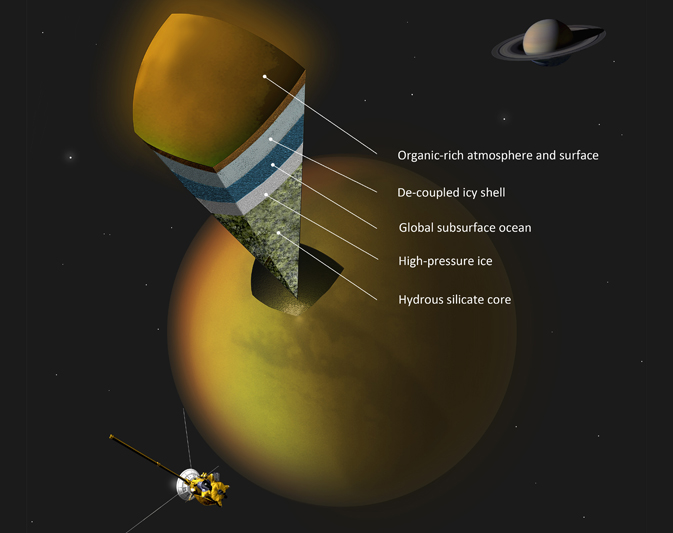
Data from NASA's Cassini spacecraft have revealed Saturn's moon Titan likely harbors a layer of liquid water under its ice shell.
Researchers saw a large amount of squeezing and stretching as the moon orbited Saturn. They deduced that if Titan were composed entirely of stiff rock, the gravitational attraction of Saturn would cause bulges, or solid "tides," on the moon only 3 feet (1 meter) in height. Spacecraft data show Saturn creates solid tides approximately 30 feet (10 meters) in height, which suggests Titan is not made entirely of solid rocky material. The finding appears in today's edition of the journal Science.

"Cassini's detection of large tides on Titan leads to the almost inescapable conclusion that there is a hidden ocean at depth," said Luciano Iess, the paper's lead author and a Cassini team member at the Sapienza University of Rome, Italy. "The search for water is an important goal in solar system exploration, and now we've spotted another place where it is abundant."
Titan takes only 16 days to orbit Saturn, and scientists were able to study the moon's shape at different parts of its orbit. Because Titan is not spherical, but slightly elongated like a football, its long axis grew when it was closer to Saturn. Eight days later, when Titan was farther from Saturn, it became less elongated and more nearly round. Cassini measured the gravitational effect of that squeeze and pull.
Scientists were not sure Cassini would be able to detect the bulges caused by Saturn's pull on Titan. By studying six close flybys of Titan from Feb. 27, 2006, to Feb. 18, 2011, researchers were able to determine the moon's internal structure by measuring variations in the gravitational pull of Titan using data returned to NASA's Deep Space Network (DSN).

"We were making ultrasensitive measurements, and thankfully Cassini and the DSN were able to maintain a very stable link," said Sami Asmar, a Cassini team member at NASA's Jet Propulsion Laboratory in Pasadena, Calif. "The tides on Titan pulled up by Saturn aren't huge compared to the pull the biggest planet, Jupiter, has on some of its moons. But, short of being able to drill on Titan's surface, the gravity measurements provide the best data we have of Titan's internal structure."

An ocean layer does not have to be huge or deep to create these tides. A liquid layer between the external, deformable shell and a solid mantle would enable Titan to bulge and compress as it orbits Saturn. Because Titan's surface is mostly made of water ice, which is abundant in moons of the outer solar system, scientists infer Titan's ocean is likely mostly liquid water.
On Earth, tides result from the gravitational attraction of the moon and sun pulling on our surface oceans. In the open oceans, those can be as high as two feet (60 centimeters). While water is easier to move, the gravitational pulling by the sun and moon also causes Earth's crust to bulge in solid tides of about 20 inches (50 centimeters).
The presence of a subsurface layer of liquid water at Titan is not itself an indicator for life. Scientists think life is more likely to arise when liquid water is in contact with rock, and these measurements cannot tell whether the ocean bottom is made up of rock or ice. The results have a bigger implication for the mystery of methane replenishment on Titan.
"The presence of a liquid water layer in Titan is important because we want to understand how methane is stored in Titan's interior and how it may outgas to the surface," said Jonathan Lunine, a Cassini team member at Cornell University, Ithaca, N.Y. "This is important because everything that is unique about Titan derives from the presence of abundant methane, yet the methane in the atmosphere is unstable and will be destroyed on geologically short timescales."
A liquid water ocean, "salted" with ammonia, could produce buoyant ammonia-water liquids that bubble up through the crust and liberate methane from the ice. Such an ocean could serve also as a deep reservoir for storing methane.

Source : NASA
www.afgastronomers.blogspot.com

Monday, April 2, 2012

Hubble Spies a Spiral Galaxy Edge-on

The NASA/ESA Hubble Space Telescope has spotted the "UFO Galaxy." NGC 2683 is a spiral galaxy seen almost edge-on, giving it the shape of a classic science fiction spaceship. This is why the astronomers at the Astronaut Memorial Planetarium and Observatory, Cocoa, Fla., gave it this attention-grabbing nickname.

While a bird's eye view lets us see the detailed structure of a galaxy (such as this Hubble image of a barred spiral), a side-on view has its own perks. In particular, it gives astronomers a great opportunity to see the delicate dusty lanes of the spiral arms silhouetted against the golden haze of the galaxy’s core. In addition, brilliant clusters of young blue stars shine scattered throughout the disc, mapping the galaxy’s star-forming regions.

Perhaps surprisingly, side-on views of galaxies like this one do not prevent astronomers from deducing their structures. Studies of the properties of the light coming from NGC 2683 suggest that this is a barred spiral galaxy, even though the angle we see it at does not let us see this directly.

Friday, March 16, 2012

NASA Releases New WISE Mission Catalog of Entire Infrared Sky

NASA unveiled a new atlas and catalog of the entire infrared sky today showing more than a half billion stars, galaxies and other objects captured by the Wide-field Infrared Survey Explorer (WISE) mission.
"Today, WISE delivers the fruit of 14 years of effort to the astronomical community," said Edward Wright, WISE principal investigator at UCLA, who first began working on the mission with other team members in 1998.
WISE launched Dec. 14, 2009, and mapped the entire sky in 2010 with vastly better sensitivity than its predecessors. It collected more than 2.7 million images taken at four infrared wavelengths of light, capturing everything from nearby asteroids to distant galaxies. Since then, the team has been processing more than 15 trillion bytes of returned data. A preliminary release of WISE data, covering the first half of the sky surveyed, was made last April.
The WISE catalog of the entire sky meets the mission's fundamental objective. The individual WISE exposures have been combined into an atlas of more than 18,000 images covering the sky and a catalog listing the infrared properties of more than 560 million individual objects found in the images. Most of the objects are stars and galaxies, with roughly equal numbers of each. Many of them have never been seen before.

WISE observations have led to numerous discoveries, including the elusive, coolest class of stars. Astronomers hunted for these failed stars, called "Y-dwarfs," for more than a decade. Because they have been cooling since their formation, they don't shine in visible light and could not be spotted until WISE mapped the sky with its infrared vision.
WISE also took a poll of near-Earth asteroids, finding there are significantly fewer mid-size objects than previously thought. It also determined NASA has found more than 90 percent of the largest near-Earth asteroids.

Other discoveries were unexpected. WISE found the first known "Trojan" asteroid to share the same orbital path around the sun as Earth. One of the images released today shows a surprising view of an "echo" of infrared light surrounding an exploded star. The echo was etched in the clouds of gas and dust when the flash of light from the supernova explosion heated surrounding clouds. At least 100 papers on the results from the WISE survey already have been published. More discoveries are expected now that astronomers have access to the whole sky as seen by the spacecraft.

"With the release of the all-sky catalog and atlas, WISE joins the pantheon of great sky surveys that have led to many remarkable discoveries about the universe," said Roc Cutri, who leads the WISE data processing and archiving effort at the Infrared and Processing Analysis Center at the California Institute of Technology in Pasadena. "It will be exciting and rewarding to see the innovative ways the science and educational communities will use WISE in their studies now that they have the data at their fingertips."

Source :NASA
www.afgastronomers.blogspot.com

Tuesday, February 28, 2012

Five Solar Eruptions in 2 Days – Beautiful High Latitude Aurora Result From Active Solar Weekend

UPDATE 02.27.12: Beautiful High Latitude Aurora Sighted
The weak CME impact on February 26, 2012 did cause some aurora in high latitude locations after a modest start. The above image was captured over Muonio, Finland late last night, a gorgeous ending to a weekend of spectacular solar eruptions and CMEs.
---------------------------------------------------------------------------------------------------------
UPDATE 02.26.12: Weak CME Impact

Though the February 24, 2012 solar eruption provided quite a show, the associated coronal mass ejection (CME) that impacted Earth's magnetic field on Feb. 26, 2012 around 4:00pm EST (2100 UT) was weak and does not appear set to cause a strong geomagnetic storm.

From February 23 through February 24 our sun produced an astonishing five solar eruptions, launched from the top, bottom, left and right sides of the solar disk. Four of those eruptions came in just a 24 hour period.

One of the eruptions, a large snaking magnetic filament, erupted during the early hours of February 24, 2012 and launched the first of two coronal mass ejections (CME) in Earth’s direction. Analysis by scientist at the Goddard Space Weather Lab shows that this CME cloud will strike Earth's magnetic field on February 26, 2012 near 8:30am EST (+/- 7 hr). Geomagnetic storms and aurora are possible when the CME arrives.


The filament eruption, as seen in the video above taken by the Solar Dynamic Observatory (SDO) in extreme ultraviolet wavelength, forms a visible split in the sun's atmosphere, where plasma races away in waves in opposite directions. The divide stretches the length of the original filament location, almost 248,500 miles (400,000 km).

Solar filaments are darker, cooler solar material floating above the sun's surface, suspended by magnetic forces. When they appear over the solar limb they are called prominences.


Source : NASA
www.afgastronomers.blogspot.com


Sunday, February 26, 2012

Aiming for an Open Window
 Why does NASA sometimes schedule a rocket launch for the middle of the night, or aim for a liftoff time when weather is notoriously unlikely to cooperate?

The simplicity of the question belies the complexity of the answer. The best time to start a mission is based on a blend of factors: the flight's target and goals, the needs of the spacecraft, the type of rocket, and the desired trajectory, which refers to the path the vehicle and spacecraft must take to successfully start the mission. Not only do these variables influence the preferred launch time -- the ideal time of departure -- but the overall length of the launch window, which can vary from one second to several hours.

The dynamics change from mission to mission, and determining the launch window is an important part of the overall flight design.
"The interesting thing about our job is each mission is almost completely different from any other mission," said Eric Haddox, the lead flight design engineer in NASA's Launch Services Program (LSP), based at Kennedy Space Center in Florida.
Haddox leads the team of agency and contractor personnel overseeing and integrating the trajectory design efforts of the spacecraft team and launch service contractor for each LSP mission. Once the spacecraft team identifies its needs, a rocket is selected, and the work of hammering out the best launch window and trajectory begins. Ultimately, the launch window and preferred liftoff time are set by the launch service contractor.

"We help everybody understand the requirements of the spacecraft and what the capabilities are of the launch vehicle, and try to mesh the two," Haddox explained.

The most significant deciding factors in when to launch are where the spacecraft is headed, and what its solar needs are. Earth-observing spacecraft, for example, may be sent into low-Earth orbit. Some payloads must arrive at a specific point at a precise time, perhaps to rendezvous with another object or join a constellation of satellites already in place. Missions to the moon or a planet involve aiming for a moving object a long distance away.            
                                                                       
For example, NASA's Mars Science Laboratory spacecraft began its eight-month journey to the Red Planet on Nov. 26, 2011 with a launch aboard a United Launch Alliance (ULA) Atlas V rocket from Cape Canaveral Air Force Station in Florida. After the initial push from the powerful Atlas V booster, the Centaur upper stage then sent the spacecraft away from Earth on a specific track to place the laboratory, with its car-sized Curiosity rover, inside Mars' Gale Crater on Aug. 6, 2012. Due to the location of Mars relative to Earth, the prime planetary launch opportunity for the Red Planet occurs only once every 26 months.

Additionally, spacecraft often have solar requirements: they may need sunlight to perform the science necessary to meet the mission's objectives, or they may need to avoid the sun's light in order to look deeper into the dark, distant reaches of space.

Such precision was needed for NASA's Suomi National Polar-orbiting Partnership (NPP) spacecraft, which launched Oct. 28, 2011 aboard a ULA Delta II rocket from Vandenberg Air Force Base in California. The Earth-observing satellite circles at an altitude of 512 miles, sweeping from pole to pole 14 times each day as the planet turns on its axis. A very limited launch window was required so that the spacecraft would cross the ascending node at exactly 1:30 p.m. local time and scan Earth's surface twice each day, always at the same local time.

All of these variables influence a flight's trajectory and launch time. A low-Earth mission with specific timing needs must lift off at the right time to slip into the same orbit as its target; a planetary mission typically has to launch when the trajectory will take it away from Earth and out on the correct course.

According to Haddox, aiming for a specific target -- another planet, a rendezvous point, or even a specific location in Earth orbit where the solar conditions will be just right -- is a bit like skeet shooting.

"You've got this object that's going to go flying out into the air and you've got to shoot it," said Haddox. "You have to be able to judge how far away your target is and how fast it's moving, and make sure you reach the same point at the same time."

But Haddox also emphasized that Earth is rotating on its axis while it orbits the sun, making the launch pad a moving platform. With so many moving players, launch windows and trajectories must be carefully choreographed.
Of course, weather or technical problems can interfere with the team's best plans. Launch windows are intended to absorb small delays while still offering plenty of chances to lift off on a given day. However, launching at a time other than the preferred time could reduce the rocket's performance, potentially limiting the payload mass.

"To launch at any time other than that optimal time, you're going to have to alter the trajectory, steer the rocket to get back to that point," Haddox said. "So that's where it becomes a trade of, 'Okay, if my window were a half hour long, how much performance would I need to fly at any time within a half hour? Or, if my window were an hour long, how much performance would I be able to get out of the rocket to fly at any time within that one hour?'"

Likewise, if a spacecraft has to use any of its onboard propellant to make up for any difference in the trajectory, that could impact the entire mission.

"The more propellant they have, the longer they can do maneuvers or adjust things" during the flight, Haddox explained. "It basically equates to how long they can stay in orbit and do their science."

These potential give-and-take situations are carefully considered during flight planning. Mission managers must find a way to balance the sacrifices while maximizing the chance of getting off the ground.


   Even when the launch and mission teams have chosen the best launch window, they face an additional challenge from the U.S. Air Force: collision avoidance, also called COLA. The U.S. Air Force's 45th Space Wing controls the Eastern Range surrounding Cape Canaveral Air Force Station in Florida; the 30th Space Wing operates the Western Range, including Vandenberg Air Force Base. The range determines whether any orbiting spacecraft or debris could strike the vehicle during its climb to space, and cut out portions of the launch window that are too risky.

Collision avoidance can get tricky, because even though the trajectory has been carefully planned, real-time factors result in some uncertainty. For example, during the trajectory design process, the team assumes certain propellant temperatures. But if the temperatures are slightly different on launch day, that will affect the propellant, which in turn alters the efficiency of the rocket's engines or solid rocket motors.

"The navigation system on the rocket is going to do what it needs to do to get the spacecraft where it needs to be, but it's not going to be the same trajectory you looked at before," said Haddox. "When you've got things that are moving seven to eight kilometers a second, half a second can result in a big distance."

"So it just makes things a lot harder to predict," he added.

On launch day, Haddox and other members of the flight design team are involved in the countdown. Even in the final hours before liftoff, they continue to fine-tune the trajectory analysis based on real-time data collected from weather balloons, ensuring the safety of the rocket and spacecraft as the window opens for another successful mission.

Source : NASA
www.afgastronomers.blogspot.com